Country: Nigeria
Africa’s biggest LNG exporter declares Force Majeure
A series of force majeure events have been declared by oil & gas operators in the Niger Delta, leading Nigeria LNG to declare its own force majeure on product supplies from the Bonny Island LNG terminal, the company has said today. Nigeria LNG is owned by NNPC (49%), Shell Gas B.V. (25.6%), Total Gaz Electricite Holdings France (15%), and Eni International (10.4%). The company has revealed that all its upstream gas suppliers have declared force majeure following their inability to produce gas due to ravaging floods that have already displaced millions in the Niger Delta. The shut-in of gas production has caused significant disruption of gas supply to Nigeria LNG, forcing the LNG exporter to operate at limited capacity. Nigeria LNG operates six LNG trains on Bonny Island with a capacity of 22.5 million tonnes per annum (mtpa). LNG represents on average almost 10% of Nigeria’s export earnings, data from the National Bureau of Statistics shows. In addition to supplying LNG to global markets, the company is also the biggest domestic supplier of cooking gas to the Nigerian market. Most of Nigeria’s LNG is exported to Europe and Asia, with key European markets such as France, Spain, and Portugal amongst its largest buyers.
Read more »
CrossBoundary Energy and ENGIE to spend $60m on Nigerian mini-grids
CrossBoundary Energy Access Nigeria (CBEA) and ENGIE Energy Access Nigeria have announced a new project finance agreement to build $60m worth of mini-grids in Nigeria. Undea the deal, both companies target the connection of 150,000 Nigerians to electricity. CBEA will finance the development and construction activities and own the projects, while ENGIE will provide long-term operations & maintenance (O&M) services for the mini-grids.
Read more »
Shell acquires West Africa’s leading provider of hybrid solar power solutions
Shell has revealed its intention to acquire Daystar Power in a bid to deliver carbon emission reductions and power cost savings to commercial and industrial (C&I) businesses in Africa. The acquisition is expected to help Daystar Power further expand beyond West Africa and into East and Southern Africa, and help grow its installed capacity to 400 MW by 2025. Africa’s solar C&I segment has witnessed significant demand in recent years, supporting the growth of several African renewable energy solutions providers. Earlier this month, AIIM and Helios-backed Starsight Energy agreed on its merger with SolarAfrica to develop a pipeline of some 1 GW of C&I projects across the continent. Shell has sought to increasingly tap into Africa’s power market while divesting from some key oil assets, especially in Nigeria. At the end of 2021, it notably launched a Shell Energy Nigeria with the aim of delivering competitive and reliable energy for power generation and industrial users via gas distribution networks.
Read more »
Petralon 54 takes action to start production from the Dawes Island Field in Nigeria by the end of 2022
Petralon 54 Ltd, a subsidiary of Petralon Energy Ltd, is in active engagement with its host community in the Niger Delta and has commenced technical and operational activities to achieve production at the Dawes Island Field by the end of 2022, the company said today. The move follows the award of the Dawes Island Marginal Field to Petralon 54 Ltd in 2021 and the issuance of its license – Petroleum Prospecting License No. 259 (PPL 259) in June 2022. The company has revealed some of its strategic initiatives to enable seamless operations at Dawes Island and restart production to raise national output. Petralon is notably in active engagement with the Host Community and its stakeholders in the Dawes Island Field to identify critical projects for implementation as well as create a formidable working partnership between Petralon 54 and its host/impacted communities. These include the traditional institutions/Council of Chiefs, Community Development Committees and other stakeholders. The company has also actioned several technical and operational initiatives, including surface well head checks and first line maintenance of the existing well head, refurbishment/reinforcement of field location infrastructure, mobilization of early well test equipment and all required field operations support facilities. Upon completion, these projects will ensure a safe resumption of production activities at Dawes Island.
Read more »
Nigeria: Accugas secures third Gas Sales Agreement of the year
Savannah Energy’s subsidiary Accugas has announced earlier today the signing of a new gas sales agreement (GSA) with Nigerian fertilizer manufacturer Notore Chemical Industries. The agreement covers the supply of up to 10 MMscf/d of gas on an interruptible and reasonable endeavours basis, based on gas availability and nominations, for an initial term of one year. Gas will be coming from Accugas’ 200 MMscf/d Uquo gas plant in Esit Eket, Akwa Ibom State. In February 2022, Accugas already entered into a new GSA with the Central Horizon Gas Company (CHGC), a subsidiary of Axxela. Under the terms of the GSA, CHGC can nominate to be delivered up to a maximum daily quantity of 5 MMscf/d. In June 2022, Accugas had also entered into a new 3-month gas sales agreement (GSA) with TransAfam Power Ltd to provide up to 35 MMscf/d of gas on an interruptible basis to the power plants of Afam Power Plc and Afam Three Fast Power in Okoloma, Rivers State. Details on the Uquo gas plant and Uquo marginal field development are available in the “Projects” section within your Hawilti+ research terminal.
Read more »
BREAKING: President Buhari gives consent to acquisition of Mobil Producing Nigeria by Seplat Energy
President Buhari has announced today that, in his capacity as Minister of Petroleum Resources, he was giving his consent to the acquisition of the entire share capital of Mobil Producing Nigeria Unlimited (MPNU) by Seplat Energy. The President’s consent was seen as a surprise by many industry observers, especially after the NNPC Ltd sought to declare a dispute between itself and MPNU in relation to their interpretation of pre-emption rights under their joint-operating agreement (JOA). NNPC had notably received last month an ex-parte order of interim injunction from the State Hight Court of Abuja restraining MPNU from completing the transaction with Seplat Energy. “Considering the extensive benefits of the transaction to the Nigerian Energy sector and the larger economy, President Muhammadu Buhari has given Ministerial Consent to the deal,” said the Nigerian Presidency in a tweet. Seplat Energy has announced its cash acquisition of MPNU back in February 2022 for $1.283bn, in what remains one of the top oil & gas deals of the year globally. By acquiring MPNU, the LSE and NSE-listed independent will take over Exxon Mobil’s entire offshore shallow water business in Nigeria which includes assets that are very rich in natural gas and gas liquids. The acquisition would increase Seplat Energy’s production by a whooping +186% while increasing its total 2P reserves by +89%. The total portfolio includes a 40% operating ownership of OMLs 67, 68, 70 and 104 and their associated infrastructure. Combined, the assets produced an average of 177,000 boepd gross in 2021 according to NUPRC data. OMLs 67, 68 and 70 form what is known in Nigeria as the “East Area”, where ExxonMobil has executed some of the most successful flaring reduction and valorization projects in the Niger Delta. Seplat Energy’s stock is already up +15% since the announcement broke out earlier today. Details on OMLs 67, 68, 70, and 104 are available in the “Projects” section within your Hawilti+ research terminal.
Read more »
Eberechukwu Oji: Nigeria needs to make gas available to all its states capital cities
By the end of its Decade of Gas in 2030, Nigeria needs to have brought gas to all its state capital cities if it wants to truly spur industrialization, ND Western CEO Eberechukwu Oji said in Abuja last week. Oji was speaking at the 21st NOG Conference & Exhibition that took place from July 4-7, 2022. “A country is considered industrialized if its industrial output stands at around 20% of its gross domestic product (GDP),” he said. “Nigeria is far below that but has an opportunity to boost manufacturing and industrial production by monetizing its natural gas reserves. To reach that goal, we need to implement policies that enable capital to flow into gas infrastructure and make gas available to all of Nigeria’s state capital cities,” he added. ND Western owns 45% of OML 34 in the onshore Niger Delta where it produces oil and natural gas. It notably operates three gas processing plants there with a combined capacity of 600 MMscf/d and supplies gas to power plants and industries. However, illiquidity in the power sector value-chain has made investments into gas production uneconomically, and demand for gas-based industrialization is seen as much more attractive for operators in Nigeria. In May this year, ND Western partnered with another Nigerian independent, First Hydrocarbons Nigeria (FHN), and with gas distributor Falcon Corporation to provide gas to the Lagos Free Zone. The Gas Infrastructure Development Agreement (GIDA) was signed with their special purpose vehicle, Optimera Energy FZE, and will start delivering an initial 5 MMscf/d of gas from 2024. “We need to unlock investments into distributing gas to all of Nigeria’s industrial hubs,” Oji explained. “Even some demand centers in the East remain in need of gas for their industries. We need to look at the originally conceived eastern gas network and make gas available in Benue, Ebonyi, and Anambra states.” Oji was speaking on the day when the Parliament of the European Union backed new rules labelling investments in gas and nuclear power plants as climate-friendly. “Nigeria needs to get down to business with these new rules and think of commercializing its gas on a much larger scale for the export and domestic market,” he commented.
Read more »Abuja’s State High Court halts Seplat Energy’s acquisition of Mobil Producing Nigeria
Last week, the State High Court of the Federal Capital Territory of Abuja made an ex-parte order of interim injunction restraining Mobil Producing Nigeria and its shareholders from completing the Share Sale and Purchase Agreement previously signed with Seplat Energy. In February 2022, and after months of negotiations, Seplat Energy had announced a $1.283bn cash proposition to acquire the shares of Mobil Producing Nigeria from ExxonMobil Corporation. This remains the biggest oil & gas transaction of the year so far, and one set to significantly expand Seplat Energy’s business in Nigeria. Mobil Producing Nigeria holds the entire operate shallow water business of ExxonMobil in Nigeria, representing some 95,000 barrels of oil equivalent per day (boepd) of working interest production. It also includes the Qua Ibo export terminal that exports oil to global markets, and the Bonny River Terminal that processes natural gas liquids into cooking gas notably. The NNPC had very early on expressed its disagreement over the deal. The state-owned giant, set to be officially unveiled as new commercial entity later this month, has sought to expand its upstream portfolio in recent years. Last year, it notably pre-empted a deal by Nigerian independent ConOil from acquiring Chevron Nigeria’s interest in OMLs 86 & 88. However, because Seplat Energy’s acquisition of Mobil Producing Nigeria is a corporate transaction and not an asset-based one, the pre-emption matter has remained subject of debate. In May, Seplat Energy had notably confirmed that it had received a letter from the NUPRC declining its consent on the transaction. The ex-parte order of interim injunction made by the State High Court last week is a response to NNPC seeking to declare a dispute between itself and Mobil Producing Nigeria in relation to their interpretation of pre-emption rights under their Joint-Operating Agreement (JOA).
Read more »
How decentralisation can support the expansion of Africa’s refining sector
by Souheil Abboud, Managing Director, VFuels LLC. Africa’s refining capacity has traditionally been concentrated around key hubs in Algeria, Egypt, South Africa and Nigeria. Combined, these four countries represent almost 75% of Africa’s installed refining capacity thanks to large-scale refineries that operate with various levels of reliability. However, Nigeria and South Africa have lost their status of refining hubs in recent years. Nigeria because of under-investment and lack of maintenance in its three state-owned refineries, and South Africa because of the gradual shut-down or conversion of its own facilities. As most African nations seek to secure their fuel supplies by building their own refineries, modular technologies and designs have been on the rise. While the trend first emerged out of Nigeria, it has quickly spread across the continent and modular refineries are now being built from West to Southern Africa. Modular technology solutions make it possible to address several critical challenges and needs of emerging markets, especially in Africa. They notably offer clients the opportunity to set up a refinery in approximately 13+ months from inception to start of production. This compares favorably with the 3+ years for a traditional “stickbuilt” refinery. Such decentralized assets also avoid a lot of the regular land, infrastructure, and logistics challenges associated with larger projects. Modular refineries have a quick return on investment (RoI) of approximately 2 years, enabling developers and their investors the ability to recoup their invested capital sooner. They offer a lot of flexibility when it comes to capex and opex, and the ability to gradually invest in additional modules to support capacity expansion over time. Finally, the modular refining technology makes project’s development simple and efficient. It notably requires less manpower and direct supervision, which in turn provides significant costs savings and reduced operating expenses. At VFuels, we have developed a solid track record of executing modular refinery projects for African clients. These include the 5,000 bpd Waltersmith refinery in Nigeria, the 10,000 bpd Conex refinery in Liberia, and the 30,000 bpd Cabinda refinery in Angola where factory acceptance tests (FAT) were completed in May 2022. As we continue to support Africa’s energy security agenda with modular refinery solutions, we also believe in the sustainability of African infrastructure assets. Earlier this year, we entered into a joint venture agreement with Earth Technologies to develop and install clean energy infrastructure for African oil & gas assets, including refineries. We also set up a collaboration with EMCO Engineering to develop water treatment facilities and deploy controls and digital solutions across various sectors in Africa.
Read more »Increasing LNG availability in Nigeria will support new sustainable development models for Nigerian industries
by Ken Etete, Group CEO, Century Group. Nigeria is one of the world’s biggest LNG exporters. Since the first train at Nigeria LNG was commissioned in 1999, the country has built a massive LNG export complex with a capacity of 22.5 million tonnes per annum (mtpa). Last year, it held a 6% market share of the global LNG export market and was the world’s 6th largest exporter of the commodity. But while Nigeria’s gas has benefited industrialization and power generation overseas, LNG has remained relatively absent of its domestic market. This is now changing along with the government promotion of gas as a transition fuel and increasing private sector investment into virtual gas pipelines. At the Century Group, we have always believed that gas was meant to play a bigger role in supporting Nigeria’s industrialisation and energy access. As early as 2011, we set up Gas Plus Synergy (GPS) to support the monetization of associated gas and reduce carbon emissions across the country’s oil & gas sector. In 2021, our efforts paid off with the signing of a Sales & Purchase Agreement with Nigeria LNG for the delivery of LNG to the domestic market. Moving forward, we will continue to expand Nigeria’s domestic gas value-chain, and are committed to incentivize the switching from diesel to gas across sectors such as manufacturing and transport. This will support new sustainable development models for Nigerian industries, and ultimately make the economy more resilient. As Nigeria recovers from a recession caused by the Covid-19 pandemic and crash in oil prices, there are several reasons to be bullish on the future of its domestic gas market. To begin with, the country has increasingly become aware of the potential to develop its 206 Tcf of gas reserves both for the domestic and for the export markets. The 2020-2030 period has been declared “Decade of Gas” and is seeing several incentives to boost gas monetization. Nigeria has also taken a clear stance in favor of gas even as it thrives to reach net 0 emissions by 2060. Market dynamics are also evolving in a favorable way and will be providing positive grounds to support gas adoption moving forward. Throughout the end of 2021 and first quarter of 2022, fluctuating commodity prices have sent diesel prices soaring, generating significant operational expenses for Nigerian industries that heavily rely on diesel for power generators and logistics. As a result, demand for cheaper and cleaner fuels such as CNG and LNG is growing. It is now up to Nigerian companies and financiers to step up and meet the needs of the hour.
Read more »We must provide Nigerian operators with a modular approach to gas commercialisation
by Kayode Adeleke, CEO, RusselSmith Nigeria has made significant efforts in reducing the flaring of associated gas over the past few years. However, we are still a long way from eliminating routine flaring in the country, and too much gas remains wasted and burnt into the atmosphere. Whilst commendable initiatives such as the Nigerian Gas Flare Commercialization Programme (NGFCP) have been put in place by the government to monetize associated gas, the private sector needs to step up and find new ways to build the processing and monetization infrastructure that we need to extract as much value as possible from our gas. Globally, the oil & gas industry has succeeded in finding ways to transform even the smallest quantities of gas into commodities such as diesel, naphtha, LPG, CNG, or LNG. With its vast gas reserves, Nigeria offers a fertile ground to adopt such innovations, and the Nigerian services industry has an important role to play in introducing world-class gas processing technologies to the Nigerian market. A key challenge to the elimination of flaring in Nigeria is the proliferation of flare sites across the Niger Delta, which have made it more difficult to access or aggregate gas. However, this challenge presents unique opportunities for service companies to deploy modular and small-scale gas processing solutions from an off-take as small as 2 MMscf/d. Nigerian services companies are particularly wellplaced to take on such a responsibility, given the strong capacity that they have built over the past decade. Their ability to attract and work with global technology providers can help turn the country’s gas into valuable commodities for its industries and its economy. Nigeria already has several success stories of local companies working with global partners to monetize flared gas. With the recent introduction of the Petroleum Industry Act (PIA), now is the time to build on these successes and take them to the next level. At RusselSmith, we see tremendous prospects in gas, from small to large scale developments. In order to support the decarbonization of upstream operations and increase the availability of key products such as cooking gas, RusselSmith, through its gas subsidiary, G2L Energy Solutions, is notably working with an international partner to offer new and modular gas-to-liquids technology solutions to the Nigerian market. Our commitment to improving gas commercialization is driven by a firm belief that the success of any industry depends on the ability of its service providers to be innovative and provide their market with sustainable solutions.
Read more »First Oil expected “this month” at Ikike subsea tie-back in Nigeria
The Ikike field will be put on production this month, said this morning Victor Bandele, Deputy Managing Director at TotalEnergies EP Nigeria. His remarks were made during the opening of the Nigerian Content Seminar in Abuja, which marks the start of DMG Events’ 21st NOG Conference & Exhibition. The Ikike field is developed as a tieback to the Amenam platform on OML 99 and has a targeted peak production of 32,000 barrels per day (bpd). Its final investment decision (FID) was taken back in January 2019. The project set new local content records, with an overall Nigerian content target of 90%. The project management was fully executed in-country, along with all the detailed and basic engineering. In total, the development of Ikike create over 3,000 direct jobs, according to TotalEnergies. Details on the development of the Amenam-Kpono hub are available in the “Projects” section within your Hawilti+ research terminal.
Read more »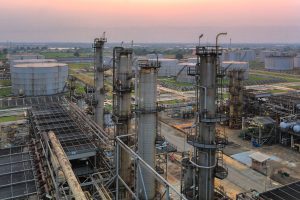
Nigeria: FEED contract awarded for new 100,000 bpd refinery in Port Harcourt
Maire Tecnimont has just announced that its subsidiary Tecnimont has been awarded a new FEED contract by African Refineries Port Harcourt Limited (ARPHL) for a new 100,000 barrels per day (bpd) refinery in Nigeria. The new plant is expected to be built inside the existing Port Harcourt Refinery complex, where Tecnimont is already rehabilitating the refinery there under a $1.5bn EPC contract. The FEED contract includes a feasibility study for the production of sustainable aviation fuel (SAF, or Biojet) based on NextChem technology, Tecnimont said. ARPHL is a consortium of Nigerian and foreign investors that won a bid to run and operate the deep conversion refinery under a PPP scheme, according to its website. ARPHL notably signed a 64-year lease with the NNPC Ltd for 45ha of land within the existing complex of the state-owned Port Harcourt Refinery. The plant is expected to be commissioned in 2025. Details on African refineries and upcoming projects can be found within the Hawilti+ research terminal and are analysed every quarter within our Quarterly Refineries Watch.
Read more »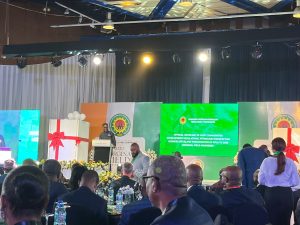
Nigeria: get to know the awardees of the latest Marginal Fields Bidding Round
Earlier this week, Nigeria held a grand ceremony in Abuja to unveil its Host Communities Development Regulations and Petroleum Prospecting Licences (PPLs) under its newly-adopted Petroleum Industry Act (PIA). The regulations are expected to provide a more durable and sustainable framework to engage local communities in the development of the country’s oil and gas sector. The PPLs regulations, on the other side, are a departure from the former regime as they mark the end of Farm-out Agreements for marginal fields. Moving forward, marginal fields will be awarded following open, competitive tenders resulting in the award of a PPL. The PPLs currently have a term of three years which can be extended by an additional three years, making the licenses valid for six years in total. The ceremony held this week is the result of the 2020 Marginal Fields Bidding Round, where 540 applicants pre-qualified, out of which 161 were declared preferred bidders. According to Minister of Petroleum Resources Chief Timipre Sylva, the round was able to generate NGN 200bn in revenues to the Nigerian government. Successful awardees who were able to pay for their signature bonuses were given their PPLs this week. They now have to form special purpose vehicles (SPVs) with their partners to develop their fields, in what was called an “arranged marriage” by many new licence owners. “Nigeria is committed to implementing full beneficial ownership disclosure of the awardees through the development of a web-portal,” said Engr. Gbenga Komolafe, Chief Executive of the new Nigerian Upstream Petroleum Regulatory Commission (NUPRC). The list of awardees announced this week, including individual entities, their respective fields and PPL numbers, is available within your Hawilti+ research terminal at plus.hawilti.com.
Read more »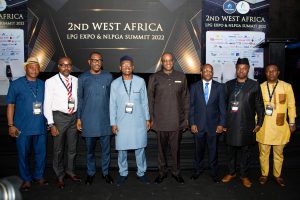
Nigerian stakeholders call for policy adjustments to increase adoption of clean cooking fuels
The Nigerian public and private sector gathered at the call of the Nigeria LPG Association (NLPGA) during the 2nd West Africa LPG Expo & NLPGA Summit 2022 in Lagos (June 23-24) to push for a stronger adoption of gas across Africa’s biggest economy. The Summit welcomed captains of the industry and leading public figures, including Chief Olusegun A. Obasanjo, Former President of Nigeria; Engr. Simbi K. Wabote, Executive Secretary of the Nigerian Content Development and Monitoring Board (NCDMB); Mr. Nuhu Yakubu, President of the NLPGA and Managing Director of Banner Energy; Dr. M.M. Ibrahim, Chairman of the National Gas Expansion Programme; Mr. Felix Ekundayo, Managing Director of ASIKO Energy and Gas Terminalling; Mrs. Nkechi Obi, Group Managing Director/CEO of Techno Oil; and Mr. Adyo Adeshina, Programme Manager of the LPG Expansion Implementation Plan within the Office of the Vice President, among others. A key takeaway from the event was a call from the industry for policy adjustments around the fiscality of LPG in Nigeria, especially on output VAT. A misplaced VAT was notably blamed for decreased LPG consumption in the country since 2021, year when supplies started to stagnate around the 1m metric tonne threshold and stopped increasing at double digit figures. Key participants also highlighted the need for better coordination amongst various governmental agencies involved across the value-chain, from customs to roads. A Push for Localisation Representatives of the Nigerian government notably explained how they are taking steps to boost LPG production and availability across the country. During the Summit, Dayo Adeshina recalled that Nigeria LNG, the country’s biggest LPG producer, recently decided to allocate all of its LPG production to the domestic market. He further revealed that talks were ongoing with additional producers of gas liquids, including ExxonMobil and Chevron, to decrease exports and supply the domestic market instead. ExxonMobil is notably operator of the Bonny River Terminal where it processes natural gas liquids into cooking gas, among others. On the other side, Chevron operates the Escravos Gas Plant and Escravos Gas-to-Liquids facility with a capacity of 33,000 barrels per day (bpd). Nigeria has some of the lowest gas penetration rates in Africa despite holding the continent’s largest proven reserves of natural gas. In 2020, the government launched the Decade of Gas initiative to try to incentive gas consumption and adoption across the economy. However, soaring prices of cooking gas since 2021 have made LPG unaffordable for many Nigerians. Increasing domestic output is seen as a solution to mitigate risks against soaring import prices, in a country that consumed slightly over 1m metric tonnes of LPG last year. The Achievements of the Gas Expansion Programme The Decade of Gas is notably backed by the Nigerian Gas Expansion Programme (NGEP), which focuses on the distribution of Autogas (CNG) and LPG across gas stations operated by the state-owned NNPC Ltd. Its immediate target, which is yet to be met, was to convert 1 million of Nigeria’s 22 million PMS-fueled vehicles to gas by 2021. During the Summit, NGEP Chairman M.M. Ibrahim shared updates on its advancement and the achievements realized so far. In 2020 and 2021, over 12,000 licensed retail outlets were notably classified as fit-for-purpose for co-locations of Autogas fuel nationwide. In parallel, revised regulatory guidelines were issued for co-located Autogas fuel retail outlets and other gas solutions. After it confirmed the potential for Autogas nationwide, Nigeria proceeded to convert and commission over 30,000 of its public mass transport buses on dual fuels while supporting auto assemblers to keep producing fit-for-purpose dual fuel vehicles in-country. These have paved the ground for an acceleration of the country’s gas promotion agenda in 2022 and 2023, in a context of soaring petroleum products prices, especially diesel. Gas was adopted by the Nigerian government as a transition fuel and will remain a critical component of its energy mix. It is also seen as the ideal substitution fuel to expensive diesel, especially for industrial customers.
Read more »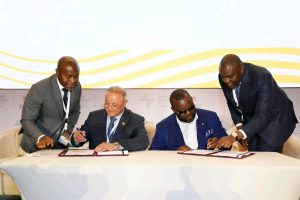
Afreximbank steps up support to first Africa-owned FLNG project
Last week in Cairo, the Afreximbank signed a Heads of Terms to support the establishment by UTM Offshore of the first Africa-owned floating LNG unit in Nigeria. Both companies had already signed a memorandum of understanding (MoU) at the end of last year. UTM Offshore has been working for a couple of years on deploying a floating unit that would process flared gas into LNG for the export market. In 2021, it received a License to Establish (LTE) and teamed up with LNG Investment Management Services (LIMS), a subsidiary of NNPC Ltd, to advance the project. It has now been joined by several international financial and technical partners, including KBR as owner’s engineer, and a consortium of JGC Corp. and Samsung Heavy Industries to execute the FEED. A final investment decision (FID) is expected in 2023 for a commissioning in 2026.
Read more »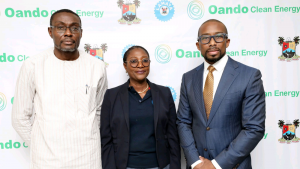
Oando planning electric mass transit ecosystem in Lagos
In April this year, Nigerian energy company Oando signed a Memorandum of Understanding (Mou) with the Lagos Metropolitan Area Transport Authority (LAMATA) for the rollout of an electric mass transit ecosystem in Africa’s largest megacity. The MoU was signed with Oando Energy Resources’ subsidiary Oando Clean Energy Ltd (OCEL). The ecosystem seeks to support electric vehicles and provide the supporting charging infrastructure and service centres for their operations. “In the immediate to medium term, we will support Lagos State in bridging the public transportation gap, commence the gradual decarbonisation of the transport sector, and in the long term, support the State in achieving optimised operational efficiency and availability of service to Lagosians,” said Ainojie Alexander Irune, COO at Oando Energy Resources. LAMATA and OCEL intend to form a public-private partnership (PPP) that will support the development of a sustainable road transport system in Lagos. Along with rapid urbanization and population growth, the state is faced with increasing challenges related to its infrastructural capacity.
Read more »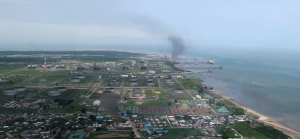
Nigeria: oil production reached historic low of only 1 million bopd in May 2022
Nigeria’s daily oil production averaged 1,024,371 barrels of oil last month, according to data by the Nigerian Upstream Petroleum Regulatory Commission (NUPRC). This marks a new all-time low for sub-Saharan Africa’s largest oil producer, who should be able to produce 2 million bopd and had its OPEC quota for May set at 1.753m bopd. Who is Under-Performing? Significant losses have been reported at the onshore Shell-operated Bonny Oil Terminal. The facility serves as an export hub for several of Shell’s onshore blocks in the Niger Delta and to several independent and marginal field operators, mostly via the Trans-Niger Pipeline (TNP). Operators exporting via the Bonny terminal suffer severe pipeline losses and crude theft. Earlier this year, Hawilti was able to view one of the terminal’s oil export data sheets, confirming that pipeline losses go as high as 90% for some operators. Meanwhile, performances have been sluggish across most of the remaining oil assets. Notable month-on-month losses have been reported at ExxonMobil’s facilities, including the Qua Iboe terminal (-44.5%) and the Erha FPSO (-37%). Who is Performing? The offshore segment, including shallow water assets operated by independents and IOCs and deep-water fields operated by IOCs are the only ones providing stable volumes. Month-on-month gains have notably been reported for Neconde Energy/NPDC via the Ugo Ocha FSO (+132%), for Eni’s Abo FPSO (+57%) and for AMNI Petroleum’s Okoro FPSO (+22%). “Deep-water assets continue to perform relatively well and are expected to keep supporting production moving forward,” said Mickael Vogel, Director & Head of Research at Hawilti. “Drilling campaigns will be helpful in that regard, with Shell currently drilling 3 infill wells at Bonga on OML 118 and TotalEnergies expected to start a multi-year drilling campaign on OML 130 later this year.” Details on Nigeria’s deep-water, shallow-water, onshore and marginal field assets are available in the “Projects” section within your Hawilti+ research terminal.
Read more »
Nigerian companies team up to provide gas to West Africa’s leading industrial hub
The Lagos Free Zone (LFZ) has officially signed earlier today a Gas Infrastructure Development Agreement with Optimera Energy FZE to develop its own gas distribution network. The new project gathers some of Nigeria’s leading gas players around a new venture committed to promoting gas-based industrialisation. West Africa’s leading industrial hub needs gas Located on the Lekki Corridor, the Lagos Free Zone covers some 830ha and is quickly emerging as West Africa’s leading integrated multi-cluster industrial zone. The project is promoted by the Tolaram Group of Singapore and is co-located with the Lekki Port, Nigeria’s deepest multi-purpose seaport, expected to be completed this year. LFZ has already been successful in attracting several industrial companies and manufacturers including TG Arla, Kellogg’s, Colgate, BASF, Saba Building Systems, or Raffles Oil amongst others. As the zone grows, it seeks to cater for potential high-growth sectors such as FMCG, pharmaceuticals, chemicals, engineering, non-metallic minerals, logistics and mixed-use. This is in return increasing the need to provide world-class infrastructure, including a reliable energy supply. Optimera Energy is now in charge of building, owning, and operating the natural gas distribution network within the free zone. The project is expected to require some $20-25m, with uninterrupted deliveries of piped gas expected to start in 2024. Initial capacity will be set at 5 MMscf/d before being gradually increased to 40 MMscf/d as demand in the zone picks up. The special purpose vehicle (SPV) gathers three of Nigeria’s strongest gas players including natural gas distributor Falcon Corporation Ltd and independent oil & gas companies ND Western and First Hydrocarbon Nigeria (FHN) via their respective subsidiaries ND Western Midstream Ltd and FHN Gas Ltd. “The Optimera consortium is made up of like-minded shareholders who are passionate about a common goal: accelerating the further growth of domestic gas utilisation in Nigeria. Having reliable dedicated gas supply infrastructure installed in the LFZ adds tremendous value to existing industrial concerns and will increase the Zone’s attractiveness to future customers.” Audrey Joe-Ezigbo, Managing Director of Optimera Energy and Deputy Managing Director of Falcon Corporation. Promoters of gas-based industrialisation Falcon Corporation has been successfully operating the Ikorodu natural gas franchise in Lagos since November 2006 and will bring its experience in building and operating gas pipeline networks for industries. The company is also a bulk distributor of Liquefied Petroleum Gas (LPG) in the domestic market and is actively developing LPG bulk storage infrastructure in the Niger Delta. On the other side, both ND Western and FHN are amongst Nigeria’s biggest gas producers from OML 34 and OML 26 in the Niger Delta, with combined gas reserves of over 4 Tcf. Via Optimera Energy, they will be transporting their gas to the Lagos Free Zone via the Escravos-Lagos Pipeline System (ELPS). ND Western has notably increasingly positioned itself as an enabler of industrialisation in Nigeria. The company already supplies gas to several power plants in the country via ELPS and exports gas to West African markets via the West Africa Gas Pipeline (WAGP). On OML 34, it has recently embarked on the development of an industrial park providing industries with direct access to cheaper gas directly at the pump. The rise of gas-to-industry in Nigeria Because the power sector remains illiquid, the promotion of gas utilization across other industries is seen as a priority under Nigeria’s Decade of Gas initiative. Chief amongst them is the expansion of the downstream gas sector, especially Autogas for cars and piped natural gas (PNG) for industries. Consequently, industrial gas off-takers are on the rise, and the volumes of domestic gas monetised by Nigerian industries (gas-to-industry) have doubled between 2015 and 2021. To know more about the trends, actors, and projects shaping up Nigeria’s natural gas sector, please log into your Hawilti+ research terminal at plus.hawilti.com.
Read more »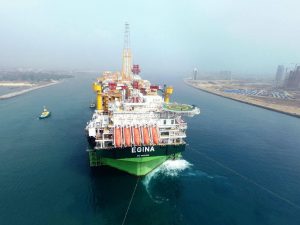
How Africa Oil Corp. made half a billion dollars from Nigeria in less than two years
Investing in Nigeria may not be for the faint-hearted, but the country continues to prove times and again that it can be a highly rewarding market. By securing an indirect interest in some of the country’s largest producing deep-water blocks in 2020, Africa Oil Corp. has shown the benefits that come with betting on Nigeria’s brownfield opportunities. In early 2020, the Canadian junior secured a 50% equity interest in Prime Oil & Gas B.V. (POGBV) for $519.5m. POGBV has an indirect 8% interest in the Chevron-operated OML 127 that contains the producing Agbami field and a 16% indirect interest in the Total-operated OML 130 that contains the producing Akpo and Egina fields. Because these represent some of Nigeria’s biggest producing assets, Africa Oil Corp.’s has relied on an average daily working interest production of 25,000 to 28,000 barrels of oil equivalent per day since 2020. Despite hedging constraining POGBV’s realized oil price to less than $60 in 2021, the company’s dividends to Africa Oil Corp. have been generous. Since January 2020, Prime has distributed eleven dividend payments totaling $500m to AOC, representing over 95% of its original equity investment. “Performance of the Company’s investment in Prime has continued to exceed expectations with strong cash flows, dividend distributions and very modest investments on the upstream assets, offshore Nigeria.” Africa Oil Corp, 13 May 2022 A Brownfield Investment Destination Nigeria offers some of the best proven reserves of oil & gas in the world, existing infrastructure and a large, established energy industry. But because of its above-ground risks, the country has repeatedly deterred foreign investors. However, deals like the one made by AOC in 2020 are proof that opportunities in the market are real. “Above-ground risks are constantly used as a pretext by foreign investors not to put their money in Nigeria. Those perceptions are often short-sighted and reveal a misunderstanding of the country’s environment. Because Nigeria is a brownfield investment destination, a successful investment strategy is one that relies on partnering with local actors who will be taking on the above-ground risks for you,” said Mickael Vogel, Hawilti’s Director & Head of Research. Last year, the country adopted the Petroleum Industry Act in a bid to bring much-needed regulatory certainty to investors. But the transition to the new regime has come with its challenges and is yet to translate into a significant increase in investments. “Recent and successful deals in Nigeria have been made by foreign companies that focus on injecting capital and bringing in technical expertise instead of seeking straightforward operatorship of the assets. In doing so, they let their Nigerian counterpart and operator navigate the country’s business environment while they focus on developing the reserves and cashing in on their investment,” added Vogel.
Read more »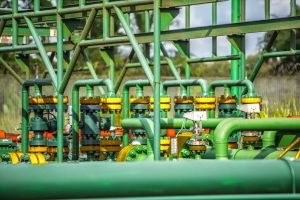
Hawilti launches gas research programme on Nigeria
Hawilti has marked the launch of its gas research programme on Nigeria with the release of a comprehensive investment report on the country’s natural gas sector earlier this week. The 2022-2023 programme seeks to analyse the growth of Nigeria’s natural gas value-chain in light of current regional and global market dynamics. While the Nigerian government had already been pushing for a stronger adoption of gas domestically, the war in Ukraine has repositioned Nigeria as a strong potential gas supplier for the export market as well. Long-stalled projects such as Brass LNG or the Nigeria-Morocco Gas Pipeline (NMGP) could benefit from renewed interest in exporting African gas. Meanwhile, the need to secure energy for Nigerian households and industries, especially in a context of soaring diesel prices, is putting pressure on the country’s gas value-chain to provide alternative solutions such as compressed natural gas (CNG), liquefied natural gas (LNG), liquefied petroleum gas (LPG) and piped natural gas (PNG). To address those challenges, Nigeria has chosen gas as its key transition fuel and named the 2020-2030 period as “Decade of Gas” in a bid to monetize its 206 Tcf of gas reserves to drive industrialization, create jobs, and generate revenue. This is in turn generating increased interests from local and foreign investors seeking to invest in the country. While little confidence exists in the strength of Nigeria’s domestic gas value-chain, long-term industry fundamentals support a strong case for investing into the country’s gas production and infrastructure. Hawilti’s research programme is developing new data sets and perspectives into the Nigerian market, focusing on private sector-led initiatives and projects across the exploration & production and midstream segments, while highlighting the growth potential of key commodities such as LPG, LNG, and CNG. All market information generated as part of the programme is now available on the Hawilti+ research programme and to Hawilti subscribers and partners. In addition, Hawilti will be expanding its suite of quarterly sector watch on the country’s LPG and small-scale LNG industries, while releasing a new comprehensive investment report twice a year.
Read more »